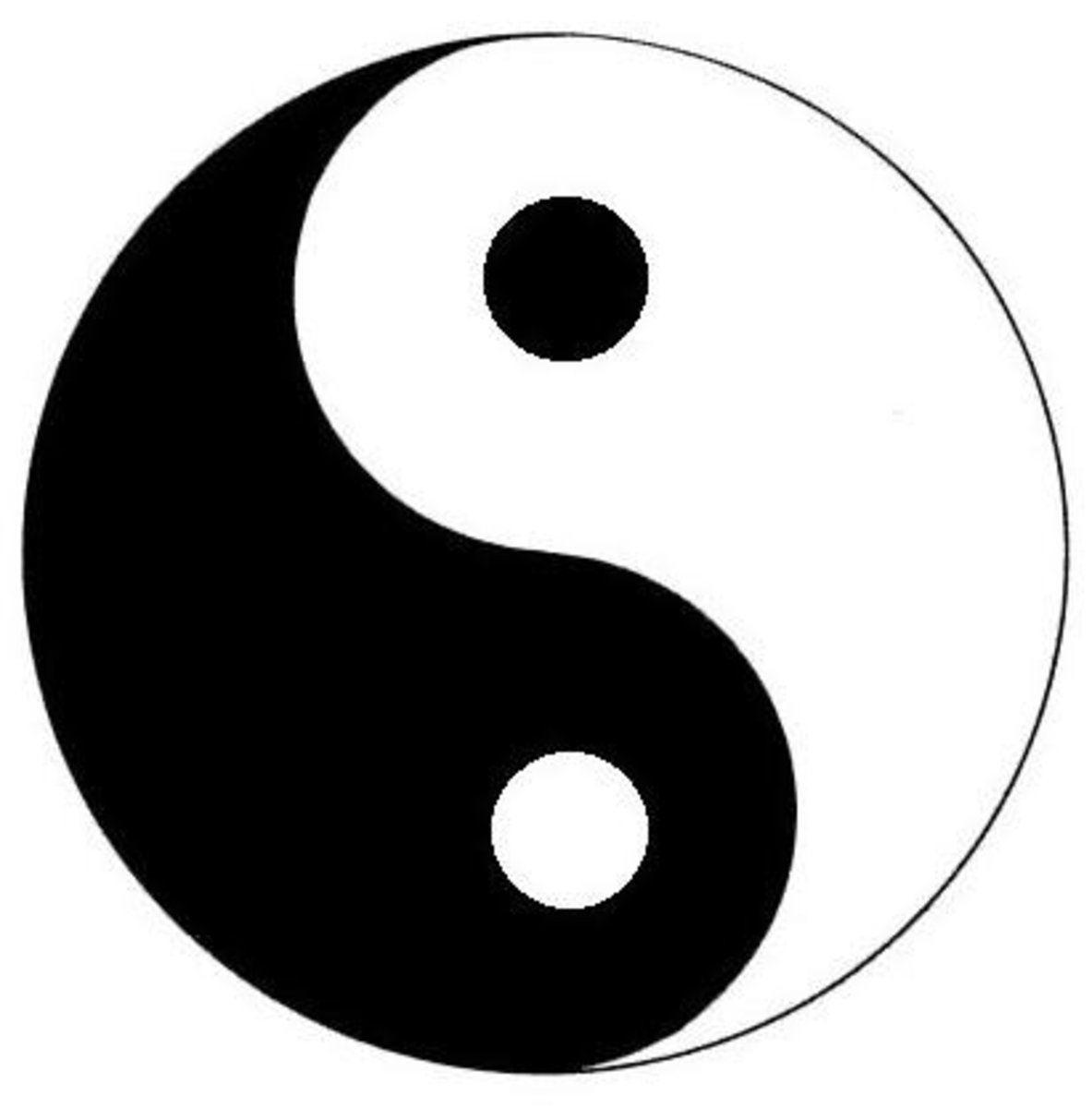
In the West, we often mistake the Taijitu (the Yin-Yang symbol) for a religious icon or a "holy" emblem. Even though Taoism is a religion, this is a category error. In its original context, the Yin-Yang is better understood as a metaphysical diagram – a topological map of how any "whole" must necessarily divide itself to become perceivable. The diagram does not represent two "things" (like water and fire) struggling for dominance; it represents the functional relationship between the observer and the observed, the potential and the actual. When Niels Bohr was knighted into the Danish Order of the Elephant in 1947, he was required to design a coat of arms. In a move that was remarkably radical for a physicist of his stature, he chose the Taijitu as his central emblem. Above the symbol, he inscribed the Latin motto: Contraria sunt complementa ("Opposites are complementary"). Bohr didn't choose the symbol because he had "gone mystical" or converted to Taoism in a religious sense. He chose it because he felt the Chinese had discovered, centuries earlier, a logical diagram for the very problem he was hitting in quantum mechanics. In the Newtonian world, a thing is either a particle or a wave; it cannot be both. This is the "Law of the Excluded Middle." Bohr’s great contribution to physics was the realisation that at the quantum level, reality requires two seemingly exclusive descriptions to be "complete." You need the particle-picture and the wave-picture.